Discover AI agents, including both registered and shadow.
Oleria uses identity intelligence to automatically detect AI agents by identifying service principals, managed identities, and application registrations with agent characteristics. No manual registration required.
What the inventory captures:
Agent name, type, and platform: Copilot Studio, Azure AI Foundry, Agentforce, etc.
Creation date: and deployment context.
Identity provider registration: Entra ID service principal, AWS IAM role, Salesforce connected apps
Authentication method and credential type: OAuth2 WIF, certificate, API key, managed identity
Complete permission scope: Including all OAuth scopes, API permissions, and role assignments
Owner identity: Specifying the human account responsible for creating or managing the agent
Dormancy status: Including last authentication, last activity, and days since last use
Application association: Indicating the enterprise application or tenant to which the agent belongs
Trace every agent back to its identity roots.
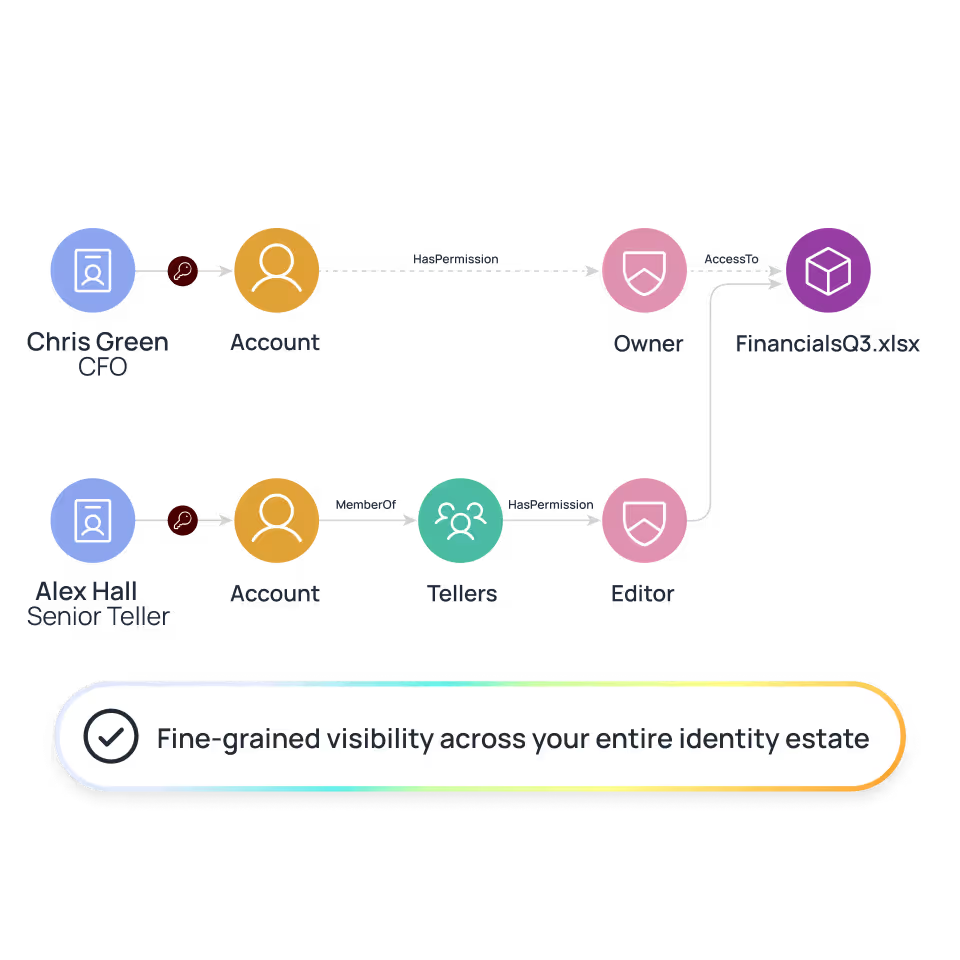
Oleria maps the complete ownership chain, including the agent’s creator, linked identities, permission flows, and compromise propagation. Agents with the same owner or permission scope are grouped, so remediating one prompts review of all related agents.
Oleria delivers:
Ownership chain: The human identity responsible for creating, owning, or managing the agent.
Identity chaining: How the agent inherits or delegates identity through delegation and impersonation. This includes both direct and indirect access via chained identities.
Permission flow: The complete entitlement path from agent to resource.
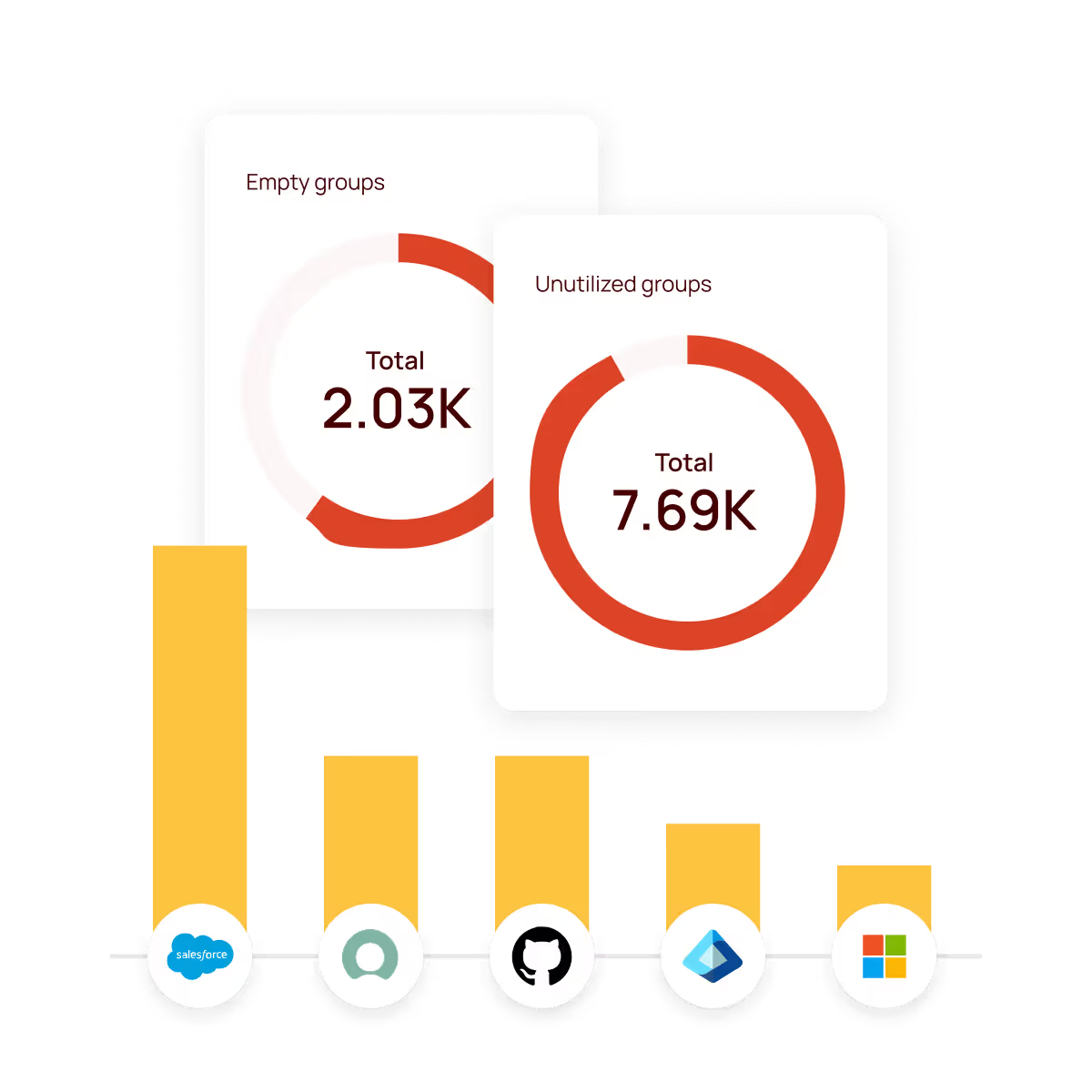
Sibling relationships: Agents that share the same owner, service principal, or permission patterns.
Lateral movement path: NHIs that share the same high-privilege access.
See exactly what every agent is doing.
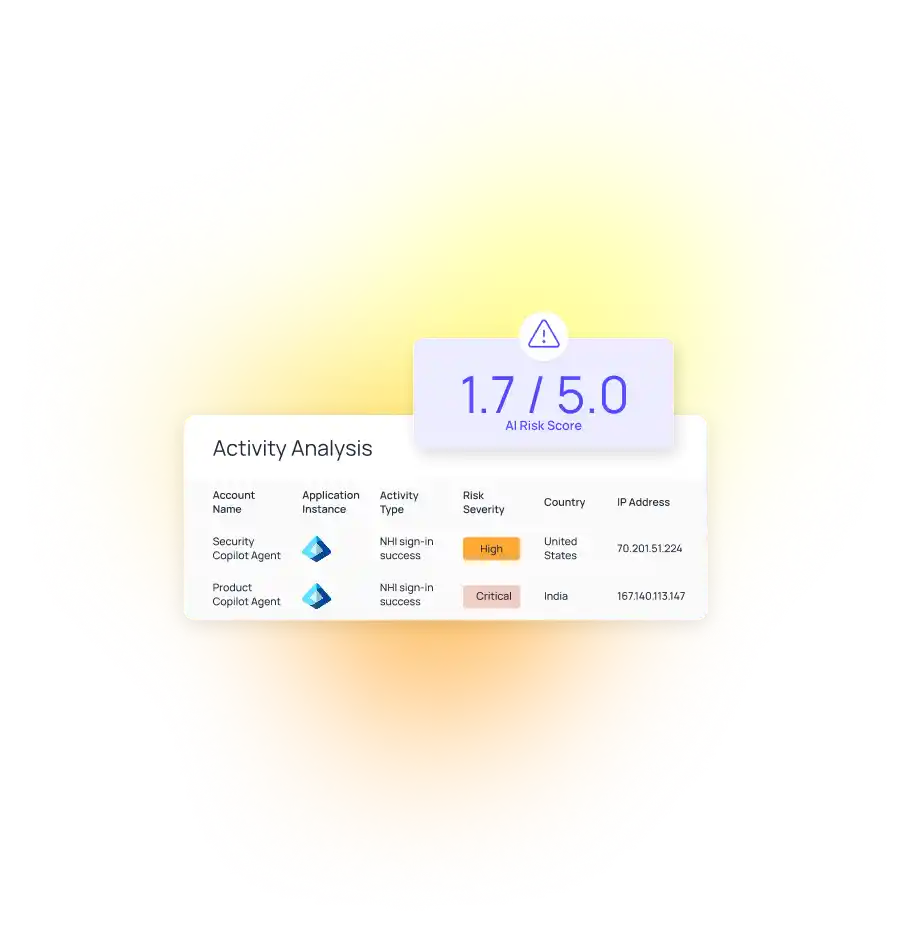
Permissions and configurations provide limited insight. Oleria monitors actual agent behavior, including authentication patterns, access usage, and inactivity. Four key signals highlight the most important findings.
Authentication events: Track the agent’s last authentication, originating IP, credential used, and any deviations from historical patterns.
Permission utilization: Identify which granted permissions are used versus dormant.
Dormancy detection: Continuously monitor agents that have ceased operating.
Behavioral baselines: Use historical activity patterns to immediately detect anomalies when behavior changes.
Get one composite score. No guesswork.
Oleria assesses AI agents across five identity-specific, weighted, and evidence-based dimensions, allowing your team to identify and resolve issues with confidence.
Privilege risk: Permissions exceeding operational purpose.
Data reach risk: The blast radius of what an agent can actually touch.
Risk violations: Active policy violations with SLA status. Dormancy exceeding threshold, over-provisioned access, weak authentication, missing ownership, stale credentials.
Owner risk: Weak MFA (email or SMS), suspicious API traffic, or excessive privileges (such as Global Admin) increase the likelihood that the human owner compromise will lead to agent compromise.
Dormancy risk: High-privilege agents with no activity present a significant attack surface. Dormancy amplifies the composite score rather than being considered alongside other dimensions.
Understand each agent’s status relative to key frameworks.
Regulatory requirements for AI agents are increasing. Oleria evaluates each agent against the EU AI Act and NIST AI RMF, providing evidence-based findings, gap analysis, and a prioritized remediation plan. No more manual evidence collection and spreadsheet audits.
EU AI Act assessment: Provides an article-by-article evaluation from Article 4 to Article 99. Includes risk tier classification, control evaluation by article (PASS, FAIL, or AT RISK), gap identification, penalty exposure quantification, and a prioritized remediation roadmap.
NIST AI RMF assessment: Delivers a four-function evaluation across Govern, Map, Measure, and Manage, including subcategory scoring.
Platform-specific considerations: Oleria also assesses the platforms where agents operate, including Azure AI Foundry, Salesforce Agentforce, and multi-platform environments.
Governance at every stage
Most organizations track agent creation, but few monitor ongoing activity, access needs, or accountability over time. Oleria addresses this with continuous governance throughout the agent lifecycle and integrates with your existing tools.
Provisioning: Enforce policy at creation. Evaluate permissions for least privilege, validate ownership, and verify authentication strength before deployment.
Continuous governance: Governance agents monitor the identity graph in real time. Receive immediate alerts when an agent gains new permissions, becomes inactive, or loses an assigned owner.
Recertification: Oleria provides each review with attached evidence, including activity history, permission usage, and ownership status, enabling efficient decision-making.
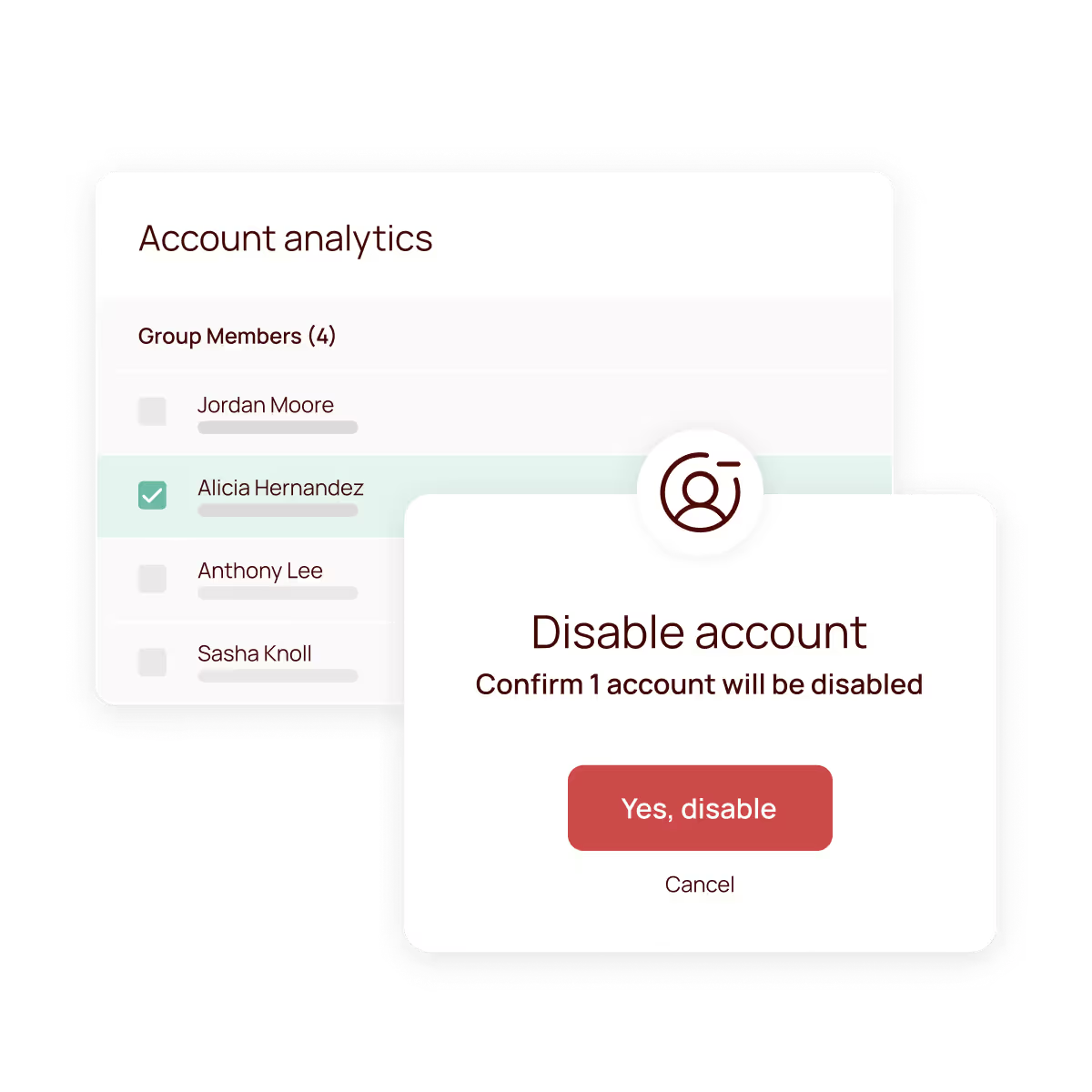
Decommissioning: Complete offboarding in one workflow. Disable identity, revoke OAuth scopes, audit lifetime access, generate evidence packages, and remove the agent from inventory.
Integrations: Oleria supplies governance intelligence across your tools while your IdP remains the system of record.

.png)
.png)
.png)
.png)
.png)
.png)